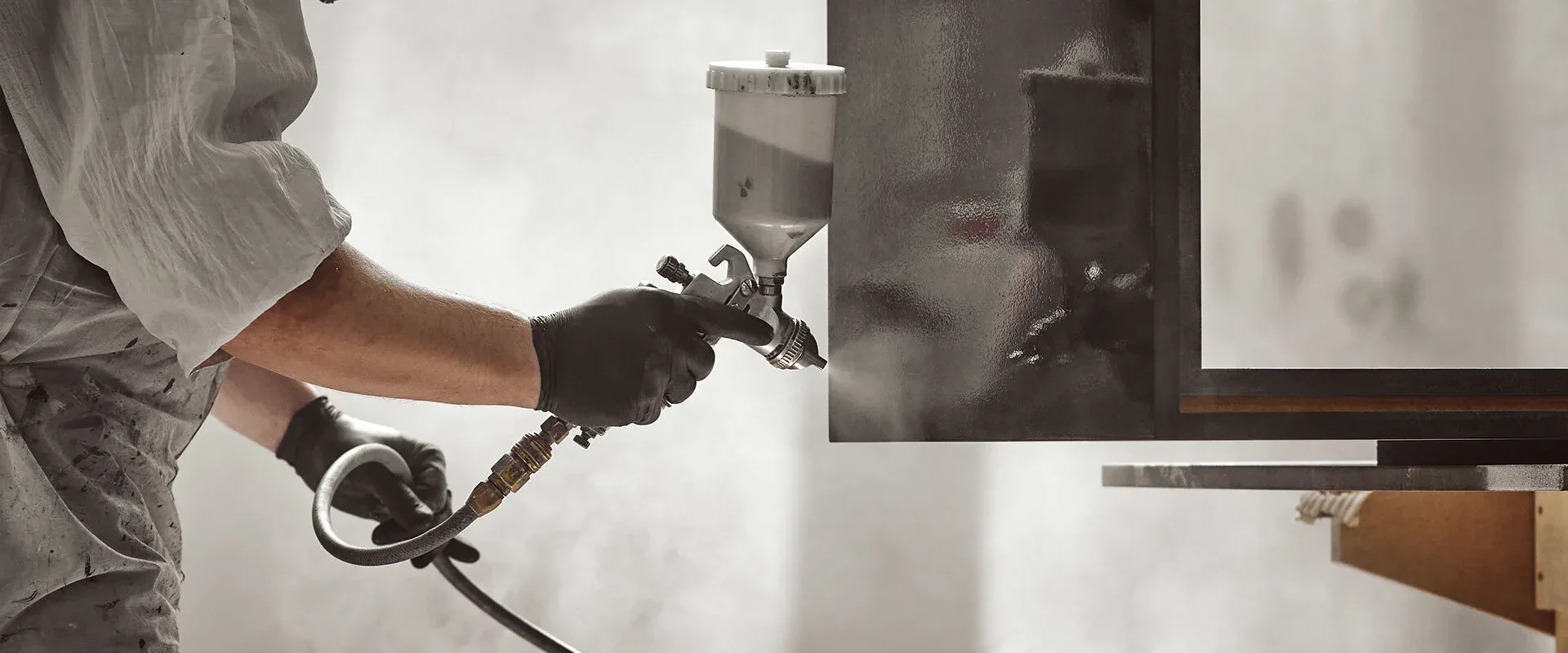
Lacquer is a coating sprayed in thin coats and sanded between each one, until the surface is as flat, even and deep as the brief asks. It can be any colour you can match and any sheen from dead matt to mirror gloss, and how it looks depends as much on what lies beneath as on the lacquer itself.
Put a lacquered door beside a painted one and the difference is not only colour. It is evenness and depth: the sprayed surface is flatter, it holds its colour across a whole run of doors, and at a high gloss it reflects the room like still water. It also shows every flaw in the board beneath it, which is why lacquer is as much about preparation as about application.
This guide explains what lacquered wood is, the main types of lacquer, how sheen and colour are chosen, how a piece is sprayed, what drives the cost and how to look after the finish. It draws on how we specify and spray finishes for furniture and joinery in hospitality and residential projects. Figures are given as a guide, and the specification for your piece always takes precedence.
What lacquer is, and what lacquered wood means
Lacquer is a resin-based or synthetic coating applied by spray. Thin coats are laid down in sequence, each one sanded and de-nibbed (the tiny specks of dust smoothed away) before the next, and the film builds into a surface that cannot be matched by brush or roller. It is used on furniture, cabinetry, joinery panels, headboards, door faces and hospitality millwork, wherever colour accuracy, consistent sheen and easy cleaning are wanted together.
“Lacquered wood” covers two different things. A clear lacquer is sprayed over timber or veneer, so the grain stays visible and the lacquer protects it. A coloured lacquer is pigmented and covers the surface completely, so the colour is the point, and the board beneath it is chosen for being flat and stable, not for its figure.
Against brushed or rolled paint, a sprayed and flat-sanded lacquer reads smoother and more even, and holds its colour more accurately across large areas. It can also be matched to a reference, which matters when new pieces have to sit beside existing ones.
What lies under the lacquer
A lacquer finish is only as good as the surface beneath it. Gloss in particular acts like a mirror: a ripple in the board, a faint joint line or an open grain pore shows in the reflection, and no amount of lacquer will hide it.
For coloured lacquer the base is usually an engineered board such as MDF, which is flat, smooth and steady through the seasons, where a solid timber panel moves with humidity and can open a hairline at a joint under a rigid film. For clear lacquer the surface is usually wood veneer or solid timber, and the first question is how the grain should read.
Two terms describe that choice. In an open-pore finish the lacquer follows the grain, so the surface still feels like timber. In a closed-pore finish the pores are filled first, and the surface reads as smooth, glassy and continuous. Neither is better in itself, but the second takes more preparation and more coats.
Types of lacquer
Lacquer is a family of coatings, not a single product, and the right one depends on where the piece will live and how hard it will work.
| Type | What it offers | Where it is used |
|---|---|---|
| Water-based | Low-VOC and fast-drying. Modern water-based systems reach durability levels that once needed solvents | Residential interiors and projects with environmental certification requirements |
| Solvent-based | The traditional spray system, valued for its flow, depth and forgiving application. Each coat partly dissolves the last, building a single fused film | Pieces where depth of finish matters most |
| Acrylic | Water-clear and non-yellowing, with colour stability under UV exposure | Pale colours and whites that must stay true over time |
| Polyurethane (PU) | Available water-based or solvent-based, with UV protection built in. The catalysed two-pack version cures by chemical reaction rather than evaporation, giving the hardest, most water-resistant film of the group | Bar tops, table tops and high-traffic commercial settings |
| Melamine | A hard, quick-drying, easy-clean system that balances toughness with speed of application | Kitchen cabinetry, office furniture and commercial counters |
Specialist systems sit alongside these: pearlescent lacquers that shift in the light, metallic lacquers, and anti-fingerprint and anti-bacterial coatings for surfaces that are touched constantly. For a bar top or restaurant table we specify a catalysed system and test it against alcohol, coffee and cleaning chemicals.
Sheen: from dead matt to mirror gloss
Sheen is specified as a percentage of reflected light, and it is independent of colour. Every point between a 10% dead matt and a 90% mirror gloss is achievable, and three steps cover most of what is asked for.
| Sheen | Character | Typical coats | Suits |
|---|---|---|---|
| 10%, dead matt | Soft, almost chalky, forgiving of fingerprints | One to two | Understated pieces, wardrobes and media walls |
| 30–40%, satin | A working balance of shine and protection; the workhorse of cabinet joinery | Three to four | Cabinetry, furniture and most joinery |
| Up to 90%, mirror gloss | Deep and reflective, flat-sanded between coats and machine-polished to finish | Three to five | Feature pieces, bar fronts and statement panels |
The same colour reads differently at each step, which is why we sample colour and sheen together and never approve them separately.
Sheen can also change within one piece. A lacquered cabinet is commonly given a higher gloss on the exterior, where the finish is seen and reflects the room, and the same colour in a matt finish on the inside. The matt interior is calmer to look into, kinder to the marks of daily use and keeps the colour continuous when a door is opened. Because a colour reads differently at each sheen, the matt is matched to the gloss on a sample, not by the colour reference alone.
Matt is the kinder surface: it is soft, it forgives fingerprints and it hides small imperfections in the board. Gloss shows everything. It needs the flattest possible base, careful flat-sanding between coats and a machine polish at the end, and it is judged by how it reflects the room, so a mirror gloss on a large panel is a decision about the whole space as much as about the piece.
How a piece is sprayed
- Preparation: the surface is sanded, filled where needed and primed until it is dead flat.
- A sealing coat: a base coat seals the surface and gives the colour coats an even foundation.
- Building the coats: colour and clear coats go on in thin layers, sanded and de-nibbed between each. One to two coats give a natural matt, three to four a satin or semi-gloss, and three to five, each flat-sanded, a deep or mirror gloss.
- Polishing: a mirror gloss is machine-polished to finish.
- Curing: the piece cures in a clean room, so that dust stays out and temperature and humidity stay steady.
Lacquer’s quick drying time is what makes this layered build practical. Coats go on the same day rather than the same week, without compromising the cure. Our spraywork facility is a dedicated, climate-controlled clean room for exactly this, which is why a finish reads as consistent across the full extent of a commission.
Colour: matching and testing
Colour is mixed to RAL, NCS or Farrow & Ball references, or matched to a physical sample: a fabric swatch, a stone offcut, an existing piece of furniture. Matches are sprayed onto test panels and, wherever possible, approved under the lighting of the project itself, because metamerism (two colours that match in one light and part company in another) can make a perfect studio match drift under warm hotel lighting. The approved panel becomes the control standard for the production run.
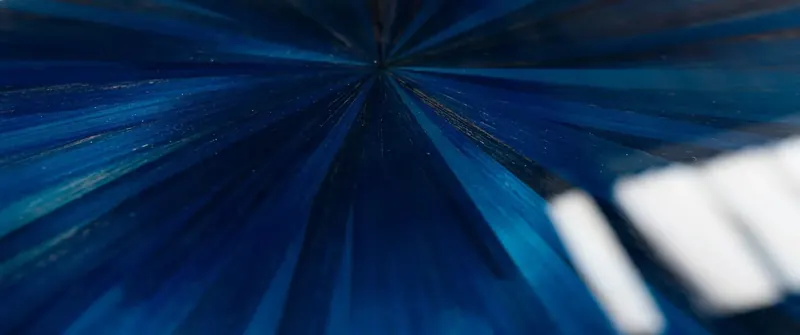
Whites and very pale colours need a lacquer that will not yellow, which is why acrylic, water-clear and non-yellowing, is the usual choice for them. Black is the most demanding colour we spray. At high gloss it behaves like dark glass, so every fraction of orange peel (the faint dimpling a rushed coat can leave) and every speck of dust shows in the reflection, and a true gloss black means more preparation coats, longer flat-sanding and a final machine polish. At matt sheens black is more forgiving but shows touch marks, so we often specify an anti-fingerprint matt system for black wardrobes, media walls and door faces.
Texture and special finishes
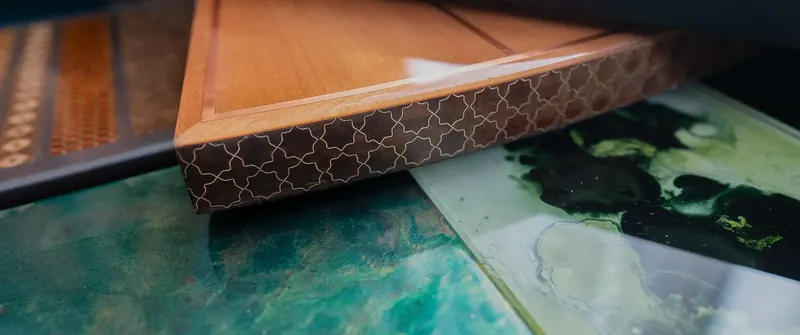
Beyond flat colour, lacquer can carry a good deal of character. Pearlescent lacquers hold mica particles that shift hue as the viewing angle changes. Metallic systems suspend fine aluminium or bronze powders for a soft sheen, which reads differently from liquid metal, a real cold-sprayed metal rather than a tinted coating. Textured finishes are built by hand: lacquer can be sprayed, blown, trickled, layered, masked and splattered into surfaces closer to artwork than to paint.
Each textured finish is developed as a sample board first, then reproduced panel by panel by the same hand, so that a full run stays consistent. Our lacquer finishes page shows a gallery of textured and specialist surfaces, from crackle and swirl to concrete, bronze and gold powder.
What drives the cost
A lacquered surface is priced by the work in it, and most of that work is in preparation and in the number of coats. These are the main factors:
- Sheen: a matt needs one or two coats, where a mirror gloss needs three to five with flat-sanding between each and a machine polish at the end.
- Colour: whites, very pale tints and black take more preparation, because they show more.
- The surface beneath: a board that starts flat needs less filling and priming, and a closed-pore finish on open-grained timber needs more.
- Form: large flat panels have to be perfectly flat, and mouldings, curves and many edges take more handwork to keep the finish even.
- Specification: a catalysed, tested system for a bar top is a different specification from a satin finish on a bedroom wardrobe.
- Texture: hand-built effects are developed on a sample board and reproduced panel by panel, which takes more time than flat colour.
That is why we ask for the drawing, the colour reference, the sheen and a note of where the piece will live, and why we suggest commissioning a sample panel early. It settles colour, sheen and texture before the full run begins.
Looking after lacquered furniture
A correctly specified lacquer needs little: a soft cloth and a mild detergent, with no abrasives and no silicone polishes. Wipe spills promptly, use mats and coasters under hot or wet items, and lift rather than drag objects across a gloss surface. Dust with a soft cloth, because grit scratches gloss faster than anything else.
Durability, touching up and repair
How long a lacquer lasts depends first on the system. A catalysed two-pack polyurethane is the hardest and most water-resistant film, melamine is hard and easy to clean, and modern water-based systems reach durability levels that once needed solvents. Then comes the base. Lacquer is a hard film, but a hard film does not stop a dent in the board beneath it, and edges and corners take the knocks first, which is why a small radius on exposed edges is worth specifying. A finish built coat by coat on a properly prepared surface will outlast one that has been rushed.
Touching up depends on the sheen and on how deep the damage goes:
- Light surface marks: on a high gloss, fine scratches that stay within the top of the film can often be polished out.
- Chips and deeper scratches: once a mark reaches the colour coats or the board, it is filled, sanded, re-coated and polished back to the surrounding sheen so that it blends in. This is local work for small damage.
- Larger or more visible damage: the panel is re-sprayed. On a gloss a local repair is harder to hide because it shows in the reflection, so a door or panel is often re-sprayed in full, while matt and satin finishes are more forgiving and easier to blend.
Two things make a repair match. The first is the colour reference and sheen specification from the original commission, so keep them with the piece. The second is the piece as it is now: colour, particularly in whites and pale tints, can shift slightly with age and light, so a repair is matched to the surface in front of it, not only to the number. Small chips are worth attention early, before they are knocked larger. Re-spraying panel by panel is one of the quiet advantages of lacquered joinery over factory-finished boards: the finish is renewable for the life of the piece.
Lacquer, French polish and oil
Lacquer is one of three finishes that most often decide the character of a wooden piece. They suit different pieces, and the choice is mostly about how much wear the surface will see and how it should feel.
| Lacquer | French polish | Natural oil | |
|---|---|---|---|
| Character | A sprayed film in any colour, from dead matt to mirror gloss | Shellac laid by hand, deep and glassy, part of the wood | Matt and natural, soaked into the timber |
| Durability | The hardest and most consistent; catalysed systems resist alcohol, coffee and cleaning chemicals | Softer; wary of heat, alcohol and standing water | Good with prompt wiping; standing liquids can mark |
| Repair | Touched in and re-polished locally, or the panel re-sprayed | Repaired by hand, layer by layer | Re-oiled locally |
| Suits | Kitchens, bars, hospitality and large coloured surfaces | Desks, cabinets and pieces treated with care | Tables, chairs and pieces where a natural feel matters |
For the hand-built alternative, see French polishing. For floors, where the choice is between oil and lacquer, see wood floor finishes. For how lacquer sits against veneer and leather within a scheme, see choosing between veneer, lacquer and leather.
Lacquer in our projects
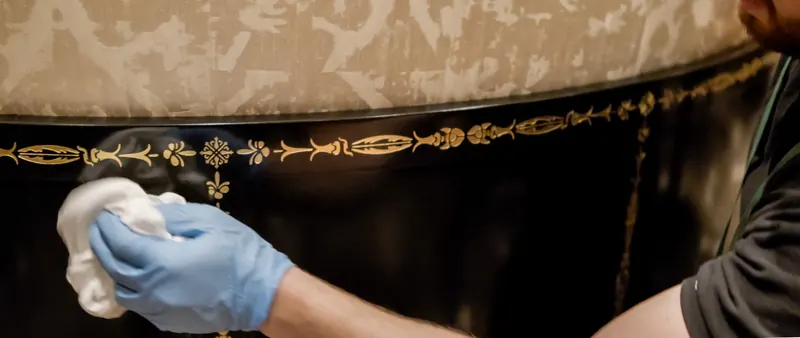
- The Grill at The Dorchester: banquettes whose outer framework and base are finished in satin black lacquer, as a contrast to the hand-applied gold motif and the upholstery.
- Julie’s Restaurant: red lacquer dining tables, bringing a concentrated colour into the main room.
- The Glass House: consoles in moisture-resistant MDF finished with a matt lacquer to protect the wood.
- St James’s Square private offices: oak and taupe lacquer storage built into wall panelling.
Questions we are asked
What is lacquered wood?
Wood, or an engineered board such as MDF, that has been coated with lacquer, a hard film sprayed on in thin coats and sanded between them. A clear lacquer protects the timber and leaves the grain visible. A coloured lacquer covers the surface entirely, and the colour and sheen are the point.
Is lacquer better than paint for furniture?
For most furniture that is seen at close range, a sprayed and flat-sanded lacquer reads smoother and more even than a brushed or rolled paint, holds its colour more accurately across large areas, and can be matched to a reference. Paint can suit a piece that will be repainted on site. The choice depends on the piece and where it will live.
How glossy can lacquer be?
Anything from a 10% dead matt to a 90% high-gloss mirror finish, specified as a percentage, with every level between available. A mirror gloss takes the most coats, each flat-sanded, and is machine-polished to finish.
How durable is lacquered furniture?
That depends on the system. A catalysed two-pack polyurethane is the hardest and most water-resistant, which is why it is specified for bar tops and restaurant tables. Melamine is hard and easy to clean. Whatever the system, a soft cloth and mild detergent look after it, and abrasives and silicone polishes should be avoided.
Can lacquer be touched up or repaired?
Yes. Light marks in a gloss can often be polished out. Chips and deeper scratches are filled, sanded, re-coated and polished back to the surrounding sheen, and larger damage means the panel is re-sprayed, which is easier to hide on a matt or satin than on a gloss. Keeping the colour reference and sheen specification from the original commission lets a repair be matched to it, and the finish stays renewable for the life of the piece.
Should the inside of a lacquered cabinet match the outside?
Usually in colour, but often not in sheen. A cabinet is commonly given a higher gloss on the exterior and the same colour in a matt finish inside, which is calmer to look into, kinder to the marks of daily use and keeps the colour continuous when a door is opened. The matt is matched to the gloss on a sample, because a colour reads differently at each sheen.
Can lacquer be matched to a colour?
Yes: to RAL, NCS or Farrow & Ball references, or to a physical sample such as a fabric swatch, a stone offcut or an existing piece. A sample panel is sprayed and approved, wherever possible under the lighting of the project, and becomes the control standard for the run.