Bespoke furniture for a private residence is designed once, for one room and one family, and made to fit a life rather than chosen from a catalogue and made to do.
A bespoke piece in a home rarely announces itself. It is the dining table you sit at for twenty years without noticing that the timber was chosen and matched by hand, the fitted wardrobe that closes with a particular quiet weight, the console that sits in an alcove as though the room had been built around it rather than the other way round. Often it was: on a project that starts with an architect's drawings, a piece can be designed into the space before the walls are finished. Bespoke residential furniture is made once, for one room and one way of living, rather than bought from a range and made to do. It is a different proposition from a hotel or a restaurant. There is no fire-safety schedule to satisfy on a domestic sofa, no covers to turn each night — but there is a different, more personal test. The piece has to earn its place in a home for years, sometimes for a lifetime, and it often has to be made around a life that is still being lived while the work goes on. This guide explains what sets bespoke apart from retail and made-to-order furniture, the kinds of work a private commission usually contains, how a piece is designed, sampled, budgeted and delivered, and what it is like to have furniture produced for your own home rather than sold to it.
What is bespoke furniture for a private residence?
Furniture for a home sits along the same spectrum as furniture for any other space. At one end is retail furniture, bought ready-made from a shop or a brand's range. In the middle is made-to-order: a stock design altered in size, finish or fabric to suit a particular room. At the other end is fully bespoke work, designed for one project alone and made to its drawings. Knowing where a piece should sit on that spectrum is the real skill in furnishing a home well, and it is worth understanding the practical difference between bespoke furniture and the alternatives before a budget is set out. Bespoke is not the right answer for every piece in a house. It earns its place where a room's proportions are unusual, where a material or a finish matters more than convenience allows for, or where a family simply wants one thing that nothing on a showroom floor can give them.
Residential work differs from a commercial fit-out in how it is bought as much as in what is bought. A hotel or office procures furniture against a formal schedule, signed off by a facilities team. A private commission is usually a more direct conversation — between a client and an interior designer, between a client and a workshop, or sometimes between an architect and a workshop with the client's taste sitting behind both. There is rarely a procurement department standing between the idea and the piece, which is part of why residential commissions can feel more personal, and why the relationship between client and maker tends to run for longer than a single project.
What residential furniture has to do
A piece for a home works differently to a piece for a hotel. It is rarely tested as hard, day for day, as a restaurant banquette on a Saturday night — but it is tested for far longer. A dining table set for a family will be sat at, leaned on, written on and gathered around for decades, by people who will notice if it starts to look tired long before it fails. The standard a residential piece has to meet is less about resisting brutal, constant wear and more about ageing well: taking on a patina rather than showing damage, holding its line and its colour as the years pass, becoming more itself rather than less.
It also has to fit invisibly into a life that keeps changing around it. A fitted piece of joinery is engineered against the exact geometry of a room, including whatever already exists inside it — the run of pipework behind a wall, the kitchen a homeowner has already chosen, the ceiling height of a listed building that was never built to a modern standard. On a project such as The Glass House in Buckinghamshire, a bespoke bar unit and a set of consoles had to integrate seamlessly with an existing Poliform kitchen inside one of Europe's largest Huf Haus — a case where the furniture's whole job was to disappear into a scheme that had already been decided elsewhere. That is a different discipline to designing a room from a blank page, and it is one a lot of retail furniture simply cannot do.
What is the difference between bespoke and retail furniture?
Retail furniture is bought as a finished range: chosen for its look and its price, built to standard dimensions that suit as many rooms as possible rather than any one room in particular. It is a sound choice for plenty of a home, and there is no case for making bespoke what a good retailer already does well.
Bespoke furniture is made once, to a set of drawings that describe this room and no other. It lets a designer or a homeowner set the proportions, the materials, the finish and the detail, so that a piece reads as though it belongs rather than as though it was fitted in afterwards. The clearest cases are the ones a catalogue was never going to solve: an alcove a few centimetres either side of a standard cabinet width, a run of wardrobes that has to step around a chimney breast, a brass utility cupboard designed with curved glazed doors specifically for one Denmark Hill kitchen, as at Camberwell House. Retail furniture forces the room to bend around the piece, and it usually shows — a gap filled with a matching panel, a run that stops one unit short of the wall. Bespoke lets the furniture follow the room instead. Our own guide to bespoke versus off-the-shelf furniture sets out the comparison in more detail.
The categories of bespoke residential work
A residential commission is easier to picture when it is broken into the kinds of work it usually contains. Most homes end up combining several of these, even on a modest project.
Fitted joinery. Wardrobes, home offices, home cinemas, home bars, media walls, staircases and wall panelling: the fixed work that is built into a room rather than placed in it. This is usually where the largest single piece of a house's budget goes, because it is repeated across several rooms and because getting it wrong is hard to undo. Our guide to bespoke fitted wardrobes and our guide to home cinema and media-room joinery cover two of the most common categories. At Country Home Cinema in Oxfordshire, grey oak panelling and horsehair upholstery were built around technology concealed so thoroughly that the room reads as a private members' screening room rather than a piece of equipment with seats in front of it.
Kitchens and kitchen-adjacent joinery. A kitchen is rarely made entirely bespoke from scratch; more often it combines a specialist kitchen company's cabinetry with bespoke pieces around it — an island, a bar, a run of consoles — produced to match. Our guide to bespoke kitchens explains how that split usually works in practice.
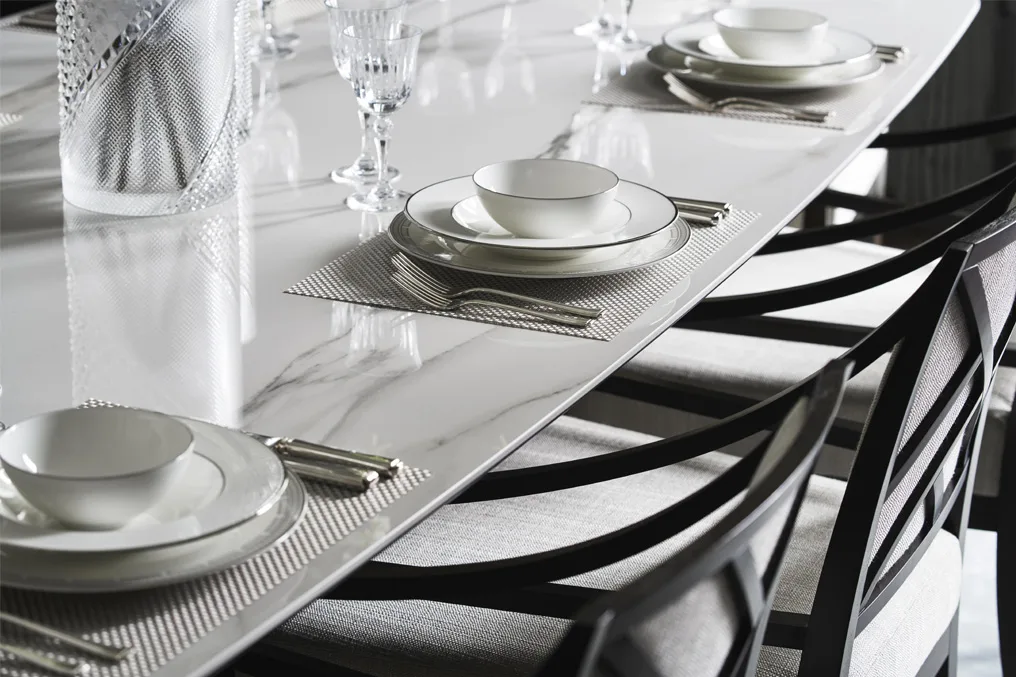
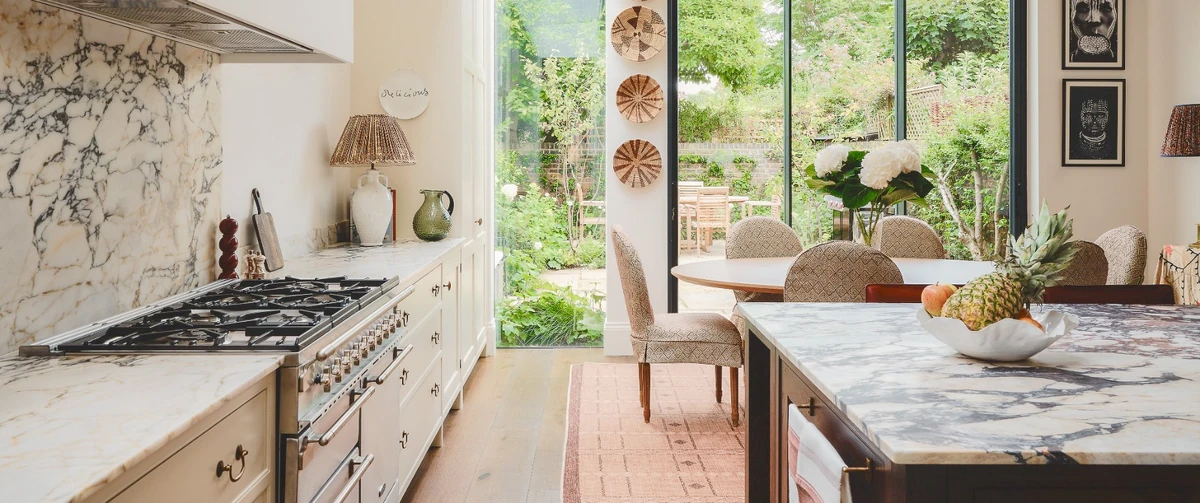
Loose furniture. Dining tables, consoles and cabinetry in solid timber, stone and metal, designed as the anchor piece in a room rather than fitted into it. At Notting Hill House, a sculptural oak dining table became exactly that for the designer Rosanna Bossom's own West London home — the piece a light-filled kitchen extension with honed marble and warm joinery was built around. Our guide to designing a bespoke dining table and our guide to bespoke cabinetry and casegoods go into the detail.
Upholstered furniture. Sofas, chairs and window seats, made to a room's proportions and a client's own sense of comfort rather than to a range's fixed sizes. At the Antibes Apartment, bespoke upholstered furniture for a penthouse overlooking the old port was kept restrained and textural, tuned to a marine climate and to the particular quality of Riviera light. Our guide to how a bespoke sofa is made explains the construction behind work like this.
Decorative surfaces and metalwork. Marquetry, straw marquetry, lacquer and bespoke metalwork are where a home's character is usually most visible, because these are the surfaces a family sees and touches every day. At Rowes Wharf Apartment in Boston, a series of bespoke marquetry panels in mother of pearl and exotic veneers translated the designer Anthony Baratta's bold pattern language into joinery at the heart of a waterfront apartment. At Taman Duta Villa in Kuala Lumpur, blue straw-marquetry door panels and a hand-laid starburst carried across a tall back-bar cabinet gave a private villa a signature that furniture alone rarely provides. Our guides to marquetry and straw marquetry, and our metalwork guide, cover the techniques behind this category.
Craftsmanship, materials and working within an existing building
Residential work asks something that hospitality rarely does: the ability to work sympathetically with a building that already exists, sometimes one that has stood for centuries. At Well Cottage, a Grade II listed Cotswolds cottage was restored using breathable mineral paints, lime-friendly fixings and bespoke joinery designed to work with the grain of an 18th-century building rather than against it — a different discipline entirely to fitting out a new-build shell, and one where the wrong material choice can trap damp in a wall that has coped perfectly well without it for three hundred years.
Material choice in a home is also judged differently to material choice in a hotel. There is less emphasis on rub counts and fire-rated interliners, and more on how a veneer will look in the specific light of a specific room, how a timber will age over a decade of daily use, and how a finish will feel under a hand that touches it every day rather than once a visit. It is one reason samples matter as much in a home as anywhere else: a finish that reads warm under a showroom's lighting can read quite differently under a north-facing kitchen window in February.
Working with an interior designer, an architect, or directly
Unlike most hospitality work, which almost always runs through a procurement team, a residential commission can arrive by several different routes. Often it comes through an interior designer, who sets the palette and the concept and relies on a workshop to develop that intent into something that can actually be built, as with The Glass House, designed by Kaoru Ishikawa and Jeff Taylor, or Fulham Reach, the Helix show home for Berkeley Homes designed by Atellior. Sometimes it comes through an architect on a new-build or a major renovation, where furniture is planned alongside the fabric of the building rather than after it. And sometimes, as with Rosanna Bossom's own dining table for Notting Hill House, the client is a designer commissioning for their own home, or a homeowner working with us directly with no designer between the idea and the piece. Whichever route it comes by, our role stays the same: the designer or the client keeps control of the idea, and we take responsibility for turning it into something that can be made, certified where it needs to be, and fitted into the room it was drawn for. Our guide to working with an interior designer sets out what that relationship usually looks like from a workshop's side of the table.
The commissioning process for a private residence
A residential commission follows a recognisable path, even where the scale of the project varies enormously between a single console and a whole house. It begins with a brief and, usually, some drawings or references — a sketch from a designer, a photograph a client has been carrying around on their phone for a year, a Poliform kitchen the new pieces have to sit beside. We review what is being asked for, advise on construction, material and finish, and quote the work so that it can be costed against a budget before anything is committed to. Once a piece is approved we prepare samples, and for anything unusual or large, a prototype, before moving into manufacture with quality checks through production. Finished work is protected, scheduled and delivered, then installed on site. Our step-by-step guide to how to commission bespoke furniture covers this in full.
The main difference from a commercial commission is pace and intimacy rather than process. There is usually one decision-maker, or a small handful of them, rather than a committee; conversations happen directly rather than through several layers of sign-off; and because the piece is often the only one of its kind being made, there is more room to slow down at the sample stage and get a detail exactly right before manufacture begins.
How is a bespoke residential commission budgeted?
Most residential projects are shaped by a budget from the outset, and the discipline that protects the design within it is the same one used on a commercial scheme: value engineering, or finding where the brief can be met more efficiently without hollowing out the character of the piece. An itemised quote makes this possible, because it shows where the money is actually going, line by line, rather than as a single number that is hard to interrogate. From there, choices can be made with intent — a hero material reserved for a dining table's top while its base uses a sympathetic, less costly alternative, or a full marquetry treatment kept for one feature wall rather than spread thinly across three. Our guide to value engineering in interior design sets out the thinking in more detail, and our guide to the cost of bespoke furniture gives a sense of where the budget for a single piece typically goes.
As with a commercial project, the most useful value engineering happens early, while a design is still flexible, rather than as a reaction to a quote that has come in over budget. Brought in at the right moment, a workshop can suggest a construction or a material that meets the same intent for less, before drawings are fixed. Left until the piece has already been drawn to one specification, the only remaining choices tend to be blunt ones.
What are typical lead times for bespoke residential furniture?
Lead time for a piece of bespoke furniture is driven by the same stages wherever it is going: drawings, sample approval, manufacture and finishing. What differs in a home is the deadline behind it. A hotel has an opening date that will not move. A house renovation usually has a moving-in date that the family would very much like to keep, but a single piece for an existing home — a console, a dining table, a cabinet — is often simply waiting to be made well rather than racing a fixed calendar. Our guide to lead times for bespoke furniture sets out realistic timeframes by category.
Where a whole house is being furnished at once, phasing still matters. Long-lead items such as decorative marquetry or a bespoke staircase are best started early, while simpler joinery is programmed to arrive as each room becomes ready to receive it. The earlier a workshop is brought in, the more comfortably a schedule can absorb the changes that come with any live renovation — and in a family home, as in a hotel, there are always changes.
Delivery and installation into a family home
Delivering into a home is a different exercise to delivering into a building site, even when building work is still underway. Floors that have just been finished, walls freshly painted, and a family often still living in part of the house all have to be protected and worked around, sometimes on the same afternoon that a new console arrives. On a listed building such as Well Cottage, installation carries an extra layer of care: fixings have to suit the fabric of the building, and a piece has to be fitted without damaging a wall or a floor that cannot simply be made good the way a new-build one can.
Snagging matters just as much in a home as anywhere else, even without a fixed opening night to answer to. A piece is checked against its specification before it is signed off, and any defect is resolved before the workshop considers the job finished. In a home the final measure of success is a quieter one than a busy restaurant on its first Friday: a family living with the piece for years without a single thing about it ever catching their attention as wrong.
What we make for private residences
- Fitted joinery, including wardrobes, home offices, home cinemas, home bars and media walls.
- Staircases and wall panelling, in timber, veneer, lacquer and metal.
- Kitchen-adjacent joinery, coordinated with kitchen specialists and existing schemes.
- Dining tables, consoles and cabinetry, in solid timber, stone and metal.
- Upholstered furniture, including sofas, chairs and window seats.
- Marquetry, straw marquetry and decorative surfaces, for feature walls, doors and cabinetry.
- Bespoke metalwork, in brass, bronze and steel, for fittings and freestanding pieces.
Working with designers and private clients
We work with interior designers, architects and private clients directly, producing furniture for a single room or an entire house. Our residential work spans London homes, country houses and private apartments abroad, including pieces for Notting Hill House with Rosanna Bossom, Camberwell House with Tim Gaudin Joinery, The Glass House with Kaoru Ishikawa and Jeff Taylor, the Antibes Apartment with Lucinda Taylor, Rowes Wharf Apartment with Anthony Baratta, Taman Duta Villa with GA Design, Fulham Reach with Atellior, Country Home Cinema with Rachel Battais Interiors, and our own restoration of Well Cottage in the Cotswolds. What stays with us is not the address but the moment a finished piece is first lived with — a table set for the first time, a cupboard door that closes exactly as it should, a room that finally feels finished. You can see more examples across our projects, the full range of residential furniture and joinery we produce, or how we work with practices on our page for the trade.
Common questions
What is the difference between bespoke and off-the-shelf furniture for a home? Off-the-shelf furniture is bought ready-made to standard dimensions, chosen for its look and its price. Bespoke furniture is designed for one room and made to its exact measurements, materials and finish, so it fits precisely and carries a detail a catalogue piece cannot. Both have their place; bespoke earns its cost where fit, material or character make a standard piece a compromise.
Do I need an interior designer to commission bespoke furniture? No. Many of our residential commissions come through an interior designer or architect, but plenty come directly from a homeowner with a clear idea and no one else involved. We are happy to work either way, developing a brief into drawings and samples whichever route it arrives by.
Can bespoke furniture be made for a listed building? Yes, with the right care taken over materials and fixings. Work in a listed or historic building has to respect the fabric it is going into — breathable finishes, sympathetic fixings and construction that can be removed without damage where required — and it is a discipline we have direct experience of, from our own restoration of a Grade II listed Cotswolds cottage.
.webp)