Quartz is a man-made surface made of ground quartz and resin, while quartzite is a natural stone. They sound almost the same and sit side by side in showrooms, but they behave differently in heat, sunlight, sealing and appearance.
The two names are one of the most common sources of confusion when choosing a worktop. Both are very hard, both are sold in light and dramatic colours, and both are described as low maintenance. But one is manufactured and the other is quarried, and that decides how each looks, how each wears and what each asks of you.
This guide compares engineered quartz and natural quartzite so you can see which suits your project. We work with natural stone, including a large range of quartzite, and we are glad to talk through either route with you.
Quartz and quartzite at a glance
| Quartz (engineered stone) | Quartzite (natural stone) | |
|---|---|---|
| What it is | Man-made: ground quartz bound with resin and pigment, formed into a slab | Natural: sandstone fused into a dense rock by heat and pressure |
| Pattern | Consistent and repeatable, designed in the factory | Unique to each slab, with natural movement |
| Hardness | Hard; the surface is quartz in resin | About 7 on the Mohs scale |
| Heat | The resin can scorch or mark, so use a trivet | Tolerates heat; use a trivet |
| Stains and sealing | Non-porous, so it does not need sealing | Porous to some degree, so it needs sealing |
| Sunlight outdoors | Resin can discolour in strong UV, so it is not generally used outside | Stable in sunlight, so it can be used outside |
| Repair | Chips can be filled; deep damage is hard to hide | Chips can be filled and the surface re-polished |
| Cutting dust | Contains a very high proportion of crystalline silica | Contains a high proportion of crystalline silica |
| Best suited to | Uniform, low-maintenance surfaces | Statement surfaces, outdoor use, bookmatched pieces |
What engineered quartz is
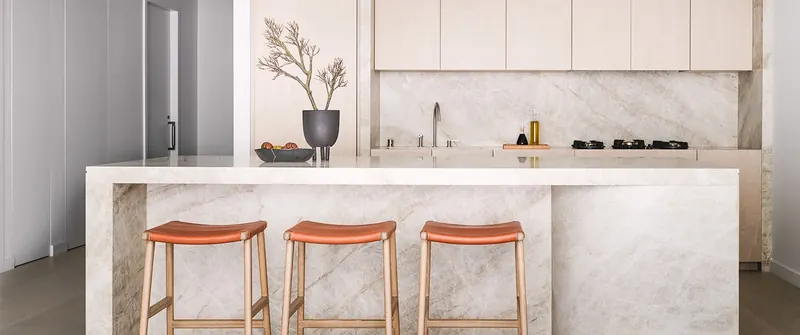
Engineered quartz, sometimes called quartz stone or engineered stone, is made in a factory. Crushed quartz, which commonly makes up well over three quarters of the slab, is mixed with polymer resin and pigment, pressed and cured into a flat slab. Because it is made, the colour and pattern are controlled and consistent from slab to slab, which makes it easy to match across a large kitchen and to reorder later. It is non-porous, so it does not need sealing.
The trade-offs follow from the resin. Strong heat can scorch or mark the surface, so a trivet under a hot pan matters, and strong sunlight over time can fade or yellow it, which is why it is generally kept indoors.
What quartzite is
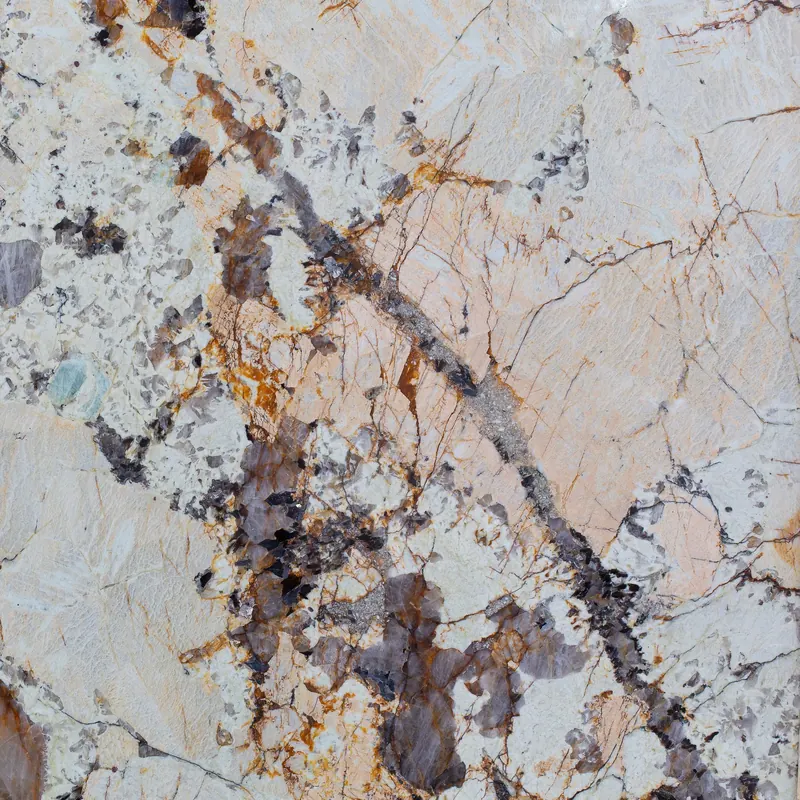
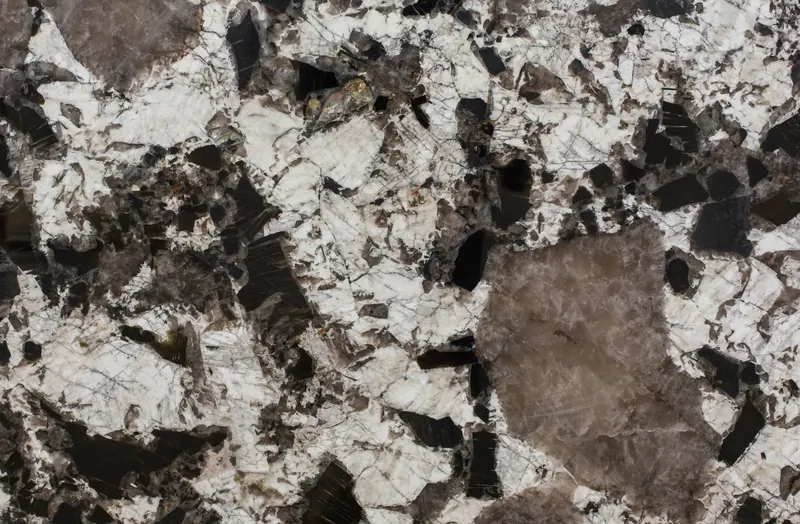
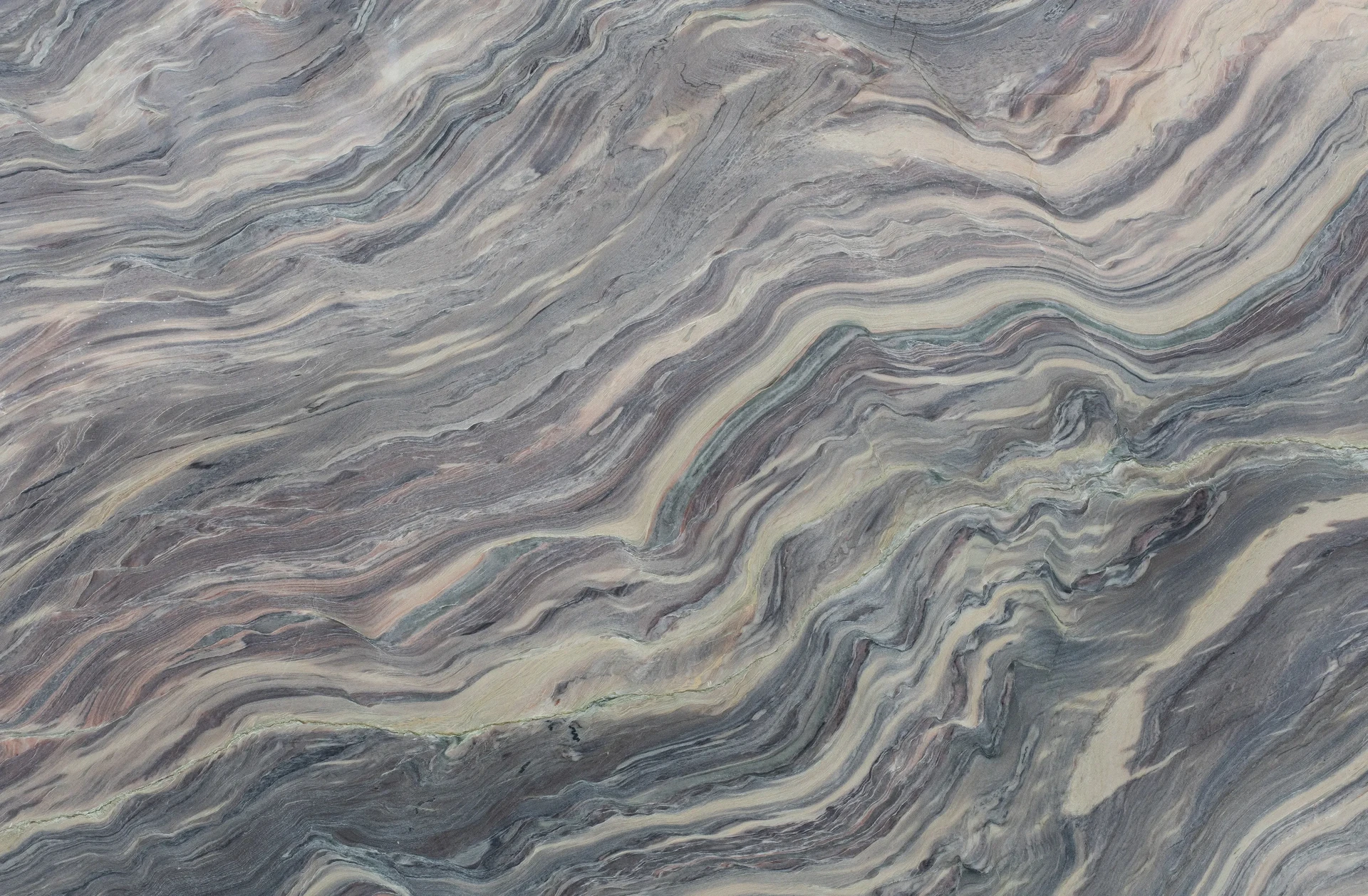
Quartzite began as sandstone. Over geological time, heat and pressure fused the quartz grains into one dense interlocking rock, with mineral traces creating the fluid colour and movement that make quartzite so sought after. It is about 7 on the Mohs scale, tolerates heat, is stable in sunlight, and is not etched by acids in the way marble is. Each slab is unique, so what you choose is the actual slab. Our guides to what quartzite is and quartzite worktops go deeper.
It asks for a little more care in return. Quartzite is porous to some degree, so it should be sealed as advised for the stone. It is also very hard and dense, which makes it more demanding to cut and polish, and a reason to have it fabricated by people who know it.
A warning about names: true and soft quartzite
Not everything sold as quartzite behaves like one. A few softer stones are marketed under the name, and they can etch like marble, which comes as a surprise to people who chose them for hardness. The practical protection is to ask for the specific stone to be tested, to see an offcut where possible, and to choose from a supplier who will be straight about it. We select the stones in our library with this in mind, and our ten common stone specification mistakes sheet lists the traps.
Silica: a point for fabricators and specifiers
Both materials contain crystalline silica, and cutting, grinding or polishing them releases a fine dust that is harmful if breathed in over time. Engineered stone generally has the highest proportion, which is why regulators have focused on it. A finished, installed surface is not the hazard: the risk is in the workshop and on site, and it is controlled by cutting wet or with extraction and by correct protective equipment. The HSE explains the risks, and our technical sheet on engineered stone and silica lists what to ask a fabricator.
Which should you choose?
- Choose engineered quartz if you want a uniform, low-maintenance surface that matches across a large area, with no sealing.
- Choose quartzite if you want a natural, one-of-a-kind surface, a statement island or a bookmatched feature, or if it will be used outdoors.
- Choose granite if you want the most forgiving natural stone, with a speckled rather than fluid look.
- Choose a solid surface, such as Corian, if you want no sealing, repairable surfaces and seamless joints.
Whichever you choose, ask to see the actual slab or a representative sample in your own light. Our stone library includes a bookmatch preview for every stone, and our sampling service lets you test a material before it is committed. Our wider comparison, marble, granite, quartzite and travertine compared, places quartzite among the other natural stones.
Sources
Questions we are asked
What is the difference between quartz and quartzite?
Quartz in the countertop trade means engineered stone: ground quartz mixed with resin and pigment and pressed into slabs. Quartzite is a natural stone, a sandstone that heat and pressure have fused into a dense rock. The names are similar but the materials are not.
Which is harder, quartz or quartzite?
Both are hard and both resist scratching well. Quartzite is about 7 on the Mohs scale. Engineered quartz is also hard, but it is bound with resin, which is softer and less tolerant of heat.
Does quartzite need sealing but quartz does not?
Usually, yes. Engineered quartz is non-porous, so it does not need sealing. Quartzite is porous to some degree, and some stones are more porous than others, so it should be sealed as advised for the particular stone.
Can quartz or quartzite go outdoors?
Quartzite can, because natural quartz is stable in sunlight and frost. Engineered quartz is generally not used outside, because the resin can fade or discolour in strong UV.
Is quartzite more expensive than quartz?
It depends on the stone. Many quartzites are priced as premium natural stones, and rare, dramatic slabs can cost considerably more than a standard engineered quartz, but the range is wide. Prices follow the individual slab, so we quote against the slab you choose.
Is quartzite real stone?
Yes. Quartzite is a natural metamorphic rock. Engineered quartz is a manufactured product that contains stone, so it is not natural stone in the same sense.
Is the dust from cutting quartz or quartzite harmful?
Cutting, grinding or polishing either material produces fine dust containing crystalline silica, which is harmful if breathed in over time. Engineered stone typically contains the most. It is a workshop hazard rather than a hazard of a finished surface, and it is controlled by cutting wet or with dust extraction and by proper protective equipment.
What are the alternatives if I want a low-maintenance natural look?
A dense granite is the most forgiving natural stone, and a solid surface such as Corian needs no sealing and can be repaired by sanding. Each has a different look, so we recommend seeing samples side by side.