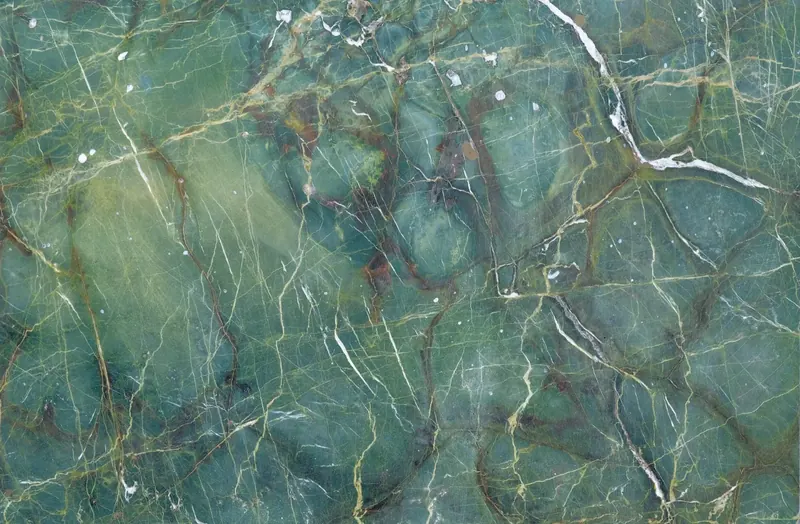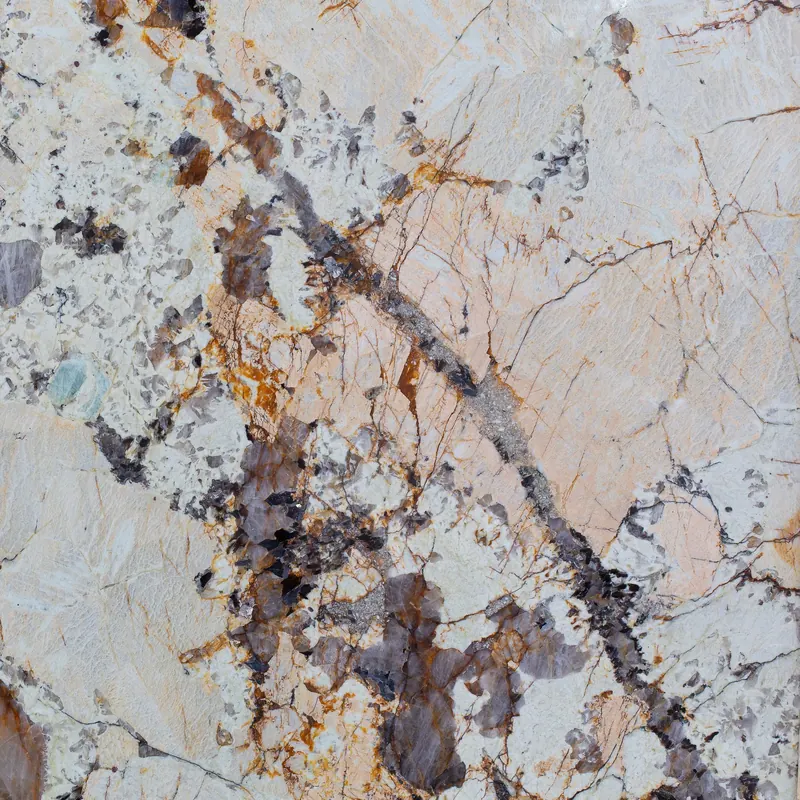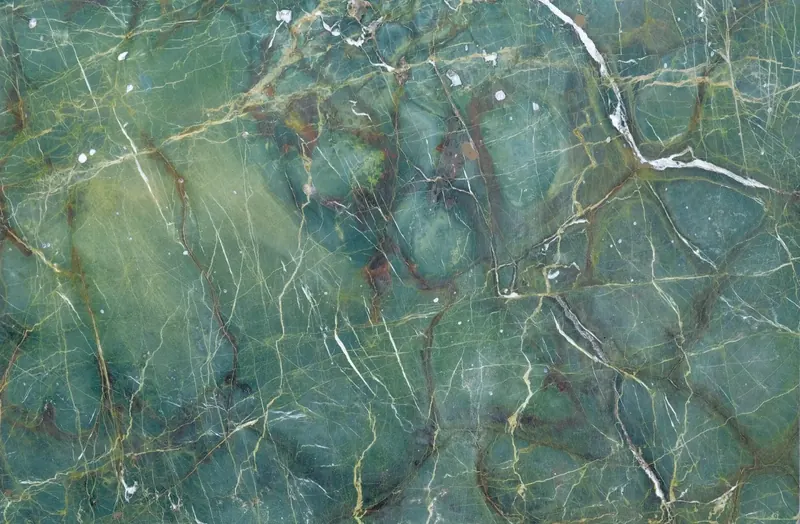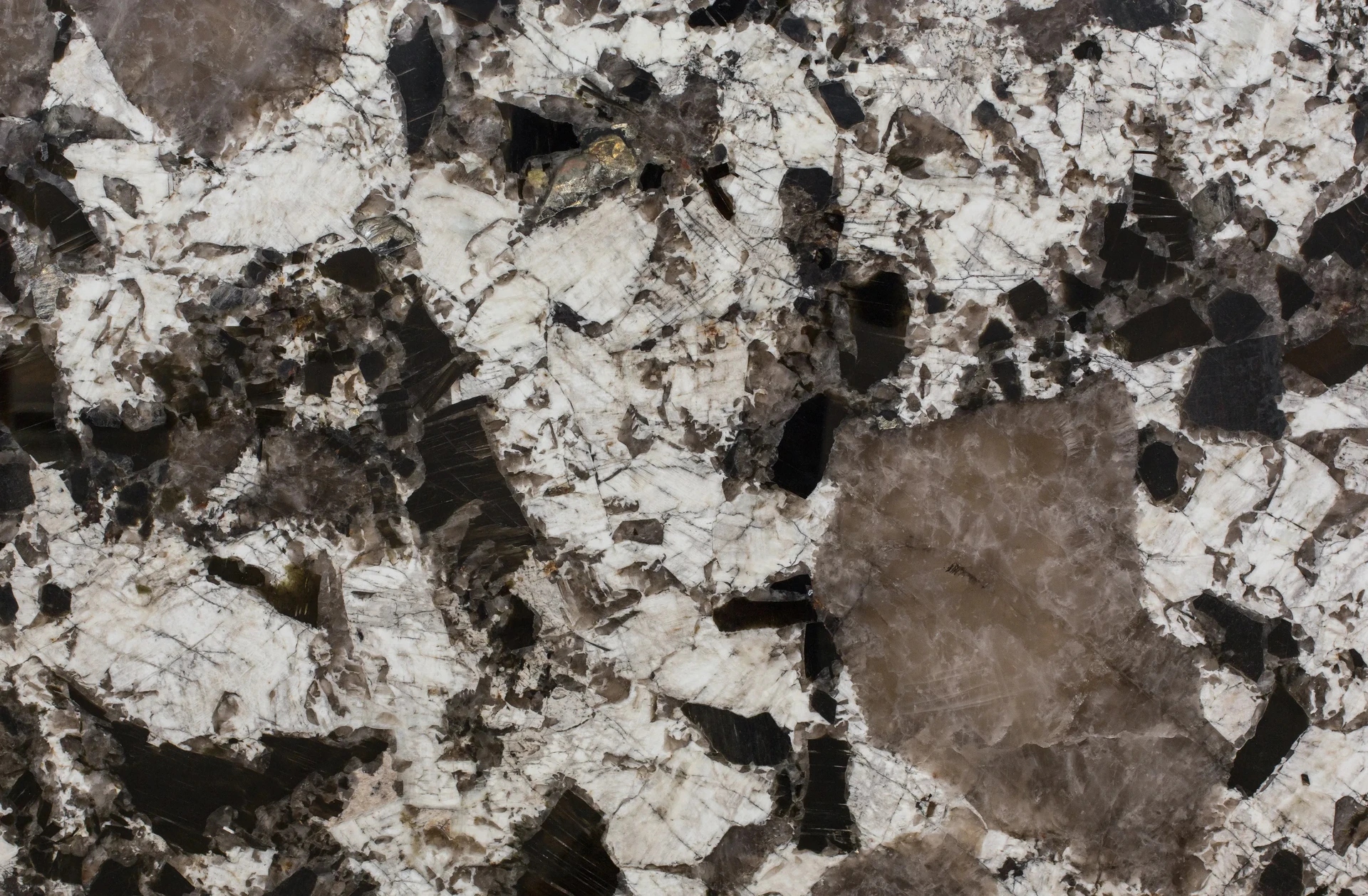
Marble, granite, quartzite and travertine are all natural stone, but they are very different materials: marble and travertine are soft and beautiful, granite and quartzite are hard and forgiving. This guide compares them side by side so you can choose the right one for the job.
People often lump these four stones together, and trade names add to the confusion. Walk into a slab yard and you will hear that granite is indestructible, that quartzite is just hard marble, or that marble stains if you look at it. Each statement is partly true and partly misleading. The real differences come from how each stone formed, and they decide how it looks, how it wears and how much care it needs.
We work with all four through our stone partners, and the stone library lets you browse them slab by slab, with a bookmatch preview for every stone. This guide explains what the differences mean in use.
The four stones at a glance
| Marble | Granite | Quartzite | Travertine | |
|---|---|---|---|---|
| What it is | Limestone recrystallised under heat and pressure | Igneous rock that crystallised slowly from molten rock | Sandstone fused by heat and pressure into a dense quartz rock | Limestone laid down by mineral-rich spring water |
| Hardness (Mohs) | About 3 to 4 | About 6 to 7 | About 7 | About 3 to 4 |
| Scratches | Marks easily, shows most on a polish | Resists well | Resists very well | Marks easily |
| Acids (citrus, wine, vinegar) | Etches | Unaffected | Unaffected in a true quartzite | Etches |
| Stains | Needs sealing; stains if neglected | Mostly resistant; seal as advised | Needs sealing; varies by stone | Needs sealing; the fill can stain |
| Heat | Tolerates heat; use a trivet | Tolerates heat; use a trivet | Tolerates heat; use a trivet | Tolerates heat; use a trivet |
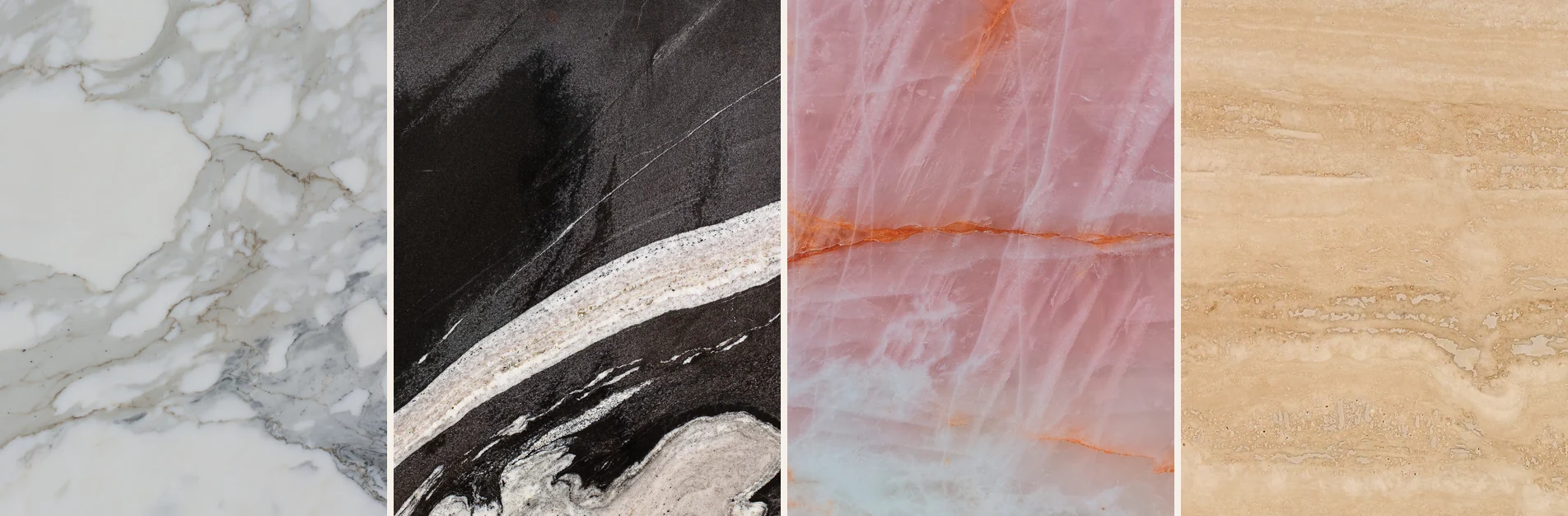
| Pattern | Flowing veins on a pale or dark ground | Speckled, flecked or swirled | Dramatic, fluid movement | Linear banding and pits, filled or open |
| Best suited to | Bathrooms, fireplaces, furniture tops, walls | Worktops, vanities, floors, outdoor use | Worktops, bar tops, table tops, walls | Floors, walls, bathrooms, indoor tops |
| In our library | Marble | Granite | Quartzite | Travertine |
The hardness figures are approximate and vary from stone to stone, so treat them as a guide. The pattern of every slab is different, which is why we agree the exact slab with you before anything is cut.
How each stone forms, and why it matters
Marble began as limestone, which is calcium carbonate. Heat and pressure recrystallised it, and the veining you see is mineral impurities drawn out into flowing lines. Because it is calcium carbonate it is soft and reacts with acids, which is why it etches. Granite crystallised slowly from molten rock into a tight mesh of quartz, feldspar and mica, which makes it hard and dense. Quartzite began as sandstone, and heat and pressure fused the quartz grains into one dense rock, so it is hard, acid-resistant and often dramatic. Travertine is a limestone deposited by hot spring water, and it keeps the pits and bands left by escaping gas and water, which are normally filled.
Hardness, scratches and etching
Two different things are often confused. Scratching is physical: a harder material marks a softer one, and it is measured on the Mohs scale. Etching is chemical: acids such as citrus, vinegar, wine and some cleaners dissolve the surface of calcium-based stone, leaving a dull mark. Marble and travertine do both more easily than granite and quartzite, and an etched polished marble top looks like a ring or a water mark that no wiping removes.
A honed or brushed finish hides etching and wear better than a mirror polish, which is why marble worktops are so often honed. A leathered or textured finish on granite or quartzite hides fingerprints and small scratches. Our guide to natural stone finishes covers the options.
Stains and sealing
All natural stone is porous to some degree, so all of it benefits from an impregnating sealer, which slows the way liquids soak in and gives you time to wipe a spill away. Sealing does not make marble immune to etching, because etching is a chemical reaction rather than a stain. A simple check is to put a few drops of water on the stone: if it darkens quickly the stone is absorbing it and needs sealing. Granites are generally the least porous, and some quartzites are very dense while others are not, so each stone should be judged individually.
Heat, weight and practical points
None of these stones is damaged by a warm dish, but sudden strong heat can crack stone and damage the sealer, so a trivet under a hot pan is sensible on any of them. Stone is heavy: a 20 mm slab weighs roughly 50 to 56 kg per square metre, and a 30 mm slab about 75 to 85 kg, so the carcass, the supports and the route into the building all matter. Our sheets on worktop thickness, overhang and support and natural stone flooring set out the details.
Choosing by use
- A hard-working family kitchen: granite or quartzite, honed or leathered, sealed as advised.
- A kitchen where a patina is welcome, or a baking slab and island: marble, honed, and expect it to age.
- A bathroom or vanity: marble, quartzite or travertine in a honed finish, sealed, with granite where you want the least upkeep.
- A table top, bar top or dining table: quartzite or granite for the hardest wear, marble for a dramatic surface that is cared for.
- Floors and wall cladding: travertine and marble for warmth and character, granite and quartzite where traffic or moisture is heavy, with a slip rating appropriate to the room.
- Outdoors: granite or quartzite, in a finish chosen for grip.
Bookmatching and choosing the slab
Because every slab is different, stone is chosen by looking at the actual slab, not a name. Bookmatching, where two consecutive slabs are opened like a book so the pattern mirrors across the joint, works best with stones that have strong movement, such as veined marble and quartzite. Every stone in our library has a bookmatch preview, so you can see how a pattern would mirror before you ask about a matched pair, and our sheet on approving a sample slab and a book-match explains how the slab is agreed.
Sources and further reading
If you are choosing a stone for a project, our stonework page explains how we work with stone, our sampling service lets you test it before it is committed, and you can get in touch at any stage.
Questions we are asked
Which is better for a kitchen worktop: marble, granite or quartzite?
For hard daily use, granite and quartzite. Both are hard, hold up to heat and are not etched by acids, so they suit a working kitchen. Marble is beautiful but softer: it etches with lemon, vinegar and wine and shows scratches, so it suits people who accept a patina, or a part of the kitchen that is used less, such as a baking slab or an island.
Is granite harder than marble?
Yes. Granite sits at about 6 to 7 on the Mohs scale and marble at about 3 to 4, so granite resists scratching far better. Granite is also not etched by acids, which marble is.
Is quartzite harder than granite?
They are close. Quartzite is about 7 on the Mohs scale and granite about 6 to 7, and both resist scratching well. A true quartzite is slightly harder and denser, which also makes it harder to cut and polish.
What is the difference between granite and quartzite?
Granite is an igneous rock made of several minerals, which gives it a speckled or flecked look. Quartzite is a metamorphic rock made almost entirely of quartz, which gives it a cleaner, more fluid pattern. In use they behave similarly, though quartzite is often the more dramatic of the two to look at.
Does travertine need sealing?
Yes. Travertine is a porous limestone, so it needs sealing, and its natural pits are normally filled at the factory and then honed or polished. It also etches with acids, so it is better suited to floors, walls and bathrooms than to a hard-working kitchen top.
Which natural stone is the lowest maintenance?
Granite, because most granites are dense, hard and resistant to acids and stains once sealed as advised. Quartzite is close behind. Marble and travertine are the most demanding, and are chosen for their look and their ageing.
Can any of these stones be used outdoors?
Granite and quartzite are the most weather-resistant, and are frost-hardy in a suitable finish. Marble and travertine can weather and etch outside, so they are used mainly indoors unless the specific stone is rated for external use.
How heavy is stone?
Roughly 2.4 to 2.8 times the weight of water. A 20 mm slab weighs about 50 to 56 kg per square metre, and a 30 mm slab about 75 to 85 kg, which is why large tops need a well-supported carcass and careful handling.