Carrara, Statuario and Calacatta are the three great white marbles of Tuscany. Carrara is the soft, classic one, Statuario is the whiter and crisper one, and Calacatta is the rare, dramatic one with the boldest veins.
These three names are used constantly, and just as constantly confused, because all three are white marble from the same mountains above Carrara in Tuscany. The difference is in the background colour and the character of the veining, and it is the reason one costs far more than another. Trade names are also used loosely, so a slab sold under one name may not match what you expected. The only safe guide is the actual slab.
This guide shows how to tell them apart, and where each suits a project. We source marble through our stone partners, and the three stones below are in our marble library, which includes a bookmatch preview for each.
Calacatta, Carrara and Statuario at a glance
| Carrara | Statuario | Calacatta | |
|---|---|---|---|
| Background | Soft white to grey-white, sometimes bluish | Bright, clean white | White to warm cream |
| Veining | Fine, feathery grey, fairly even | Bold grey, more defined than Carrara | Thick, dramatic veins in grey, gold or brown |
| Overall look | Quiet and classic | Crisp and contrasted | Dramatic and rare |
| How common | The most widely available | Less common | The rarest of the three |
| Typical price position | Generally the most affordable | Usually between the two | Generally the most expensive |
| Good for | Bathrooms, large floors and walls, classic schemes | Statement tops and cladding with a cooler, whiter look | Feature islands, bookmatched walls, showpiece surfaces |
| In our library | Bianco Carrara | Bianco Statuario | Calacatta |
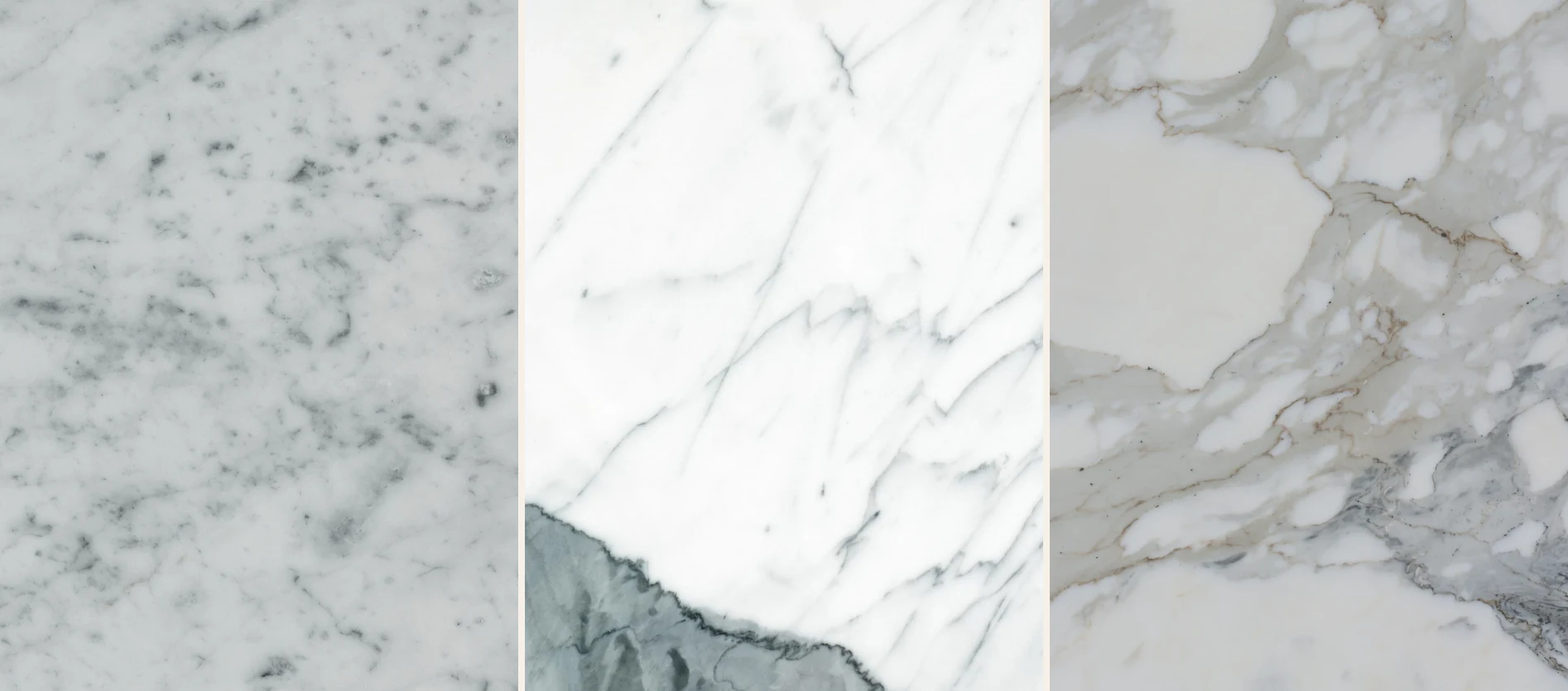
Carrara: the soft, classic white
Carrara marble is the most widely quarried and the most familiar. Its ground is a soft white to grey-white, and its veining is fine, grey and feathery, so the overall effect is calm and consistent. It is the economical choice for large areas and for classic bathrooms, floors and wall cladding. See Bianco Carrara in the library.
Statuario: bright white with bold grey veins
Statuario is named for statuary, the fine, bright white marble historically carved into sculpture. It has a cleaner, whiter ground than most Carrara, with greyer, more defined veins that give it contrast without the warmth of Calacatta. It is less common than Carrara, and prized where a cool, crisp white is wanted. See Bianco Statuario in the library.
Calacatta: rare, warm and dramatic
Calacatta has a whiter or creamier ground and thick, sweeping veins that run in grey and often in gold or brown. It is the rarest of the three, which is why it is generally the most expensive, and the one chosen for a feature island, a bookmatched wall or a showpiece. There are many Calacatta varieties, and the name is applied loosely to stones with a similar look, so it is worth seeing the slab. See Calacatta in the library, alongside Calacatta Antique and the other Calacatta stones.
Calacatta vs Carrara, and Statuario vs Calacatta
The two common comparisons come down to the same two things. Against Carrara, Calacatta is whiter or creamier, with bolder and thicker veins, and Carrara is quieter, with fine, even veining. Against Statuario, Calacatta is warmer and more dramatic, and Statuario is cooler, cleaner and tighter in its veining. If you are weighing two slabs, lay a sample of each beside your flooring, your cabinetry and your lighting, because marble changes noticeably with the light in the room.
Living with white marble
All three are marble, so they share the same behaviour. They are about 3 to 4 on the Mohs scale, so they scratch more easily than granite or quartzite, and they etch when acids such as lemon, vinegar and wine touch them. A honed finish hides etching and wear far better than a polish, an impregnating sealer slows staining, and wiping spills promptly does the rest. Many people choose white marble precisely because it ages, and accept a patina. If you want the same look with more resilience, a pale quartzite is worth a look, and our wider comparison, marble, granite, quartzite and travertine compared, sets the stones side by side. Our sheet on marble names decoded explains why the names are so loose.
Bookmatching white marble
These are the classic stones for bookmatching, because their veining mirrors beautifully across a joint, forming a pattern like an opened book, or a diamond when four slabs are matched. A real book-match uses consecutive slabs from the same block, subject to availability. To see the effect before you decide, open any stone in the library and choose Preview bookmatch. Our sheet on approving a sample slab and a book-match explains how the slab is agreed.
Sources
If you would like to see the stones in person, our sampling service can arrange samples, and you can talk to us at any stage.
Questions we are asked
What is the difference between Calacatta and Carrara marble?
Both come from the same marble district in Tuscany. Carrara has a softer white or grey-white ground with fine, feathery grey veins and is the most widely available. Calacatta has a whiter or creamier ground with thick, bold veins, often with gold or brown in them, and is rarer, so it is usually the more expensive.
What is the difference between Statuario and Calacatta?
Statuario has a bright, clean white ground with bold grey veining. Calacatta has a white to warm cream ground with thicker, more dramatic veins that can carry gold and brown. Statuario reads cooler and crisper, and Calacatta warmer and bolder.
Is Statuario the same as Calacatta?
No, though the names are sometimes used loosely in the trade. They are different marbles from the same area with different grounds and veining. Because names are applied loosely, always judge the actual slab, not the name.
Which is the most expensive: Calacatta, Carrara or Statuario?
Calacatta is generally the most expensive and Carrara the most affordable, with Statuario between them. Price follows the individual slab, its quality, its veining and its availability, so we quote against the slab you choose.
Are Carrara, Statuario and Calacatta good for kitchens?
They are beautiful, but they are marble: about 3 to 4 on the Mohs scale, they etch with acids such as lemon and vinegar and show scratches, especially when polished. A honed finish and a sealer help, and many people choose them knowing they will age. For the hardest wear, a quartzite or granite is more forgiving.
Which white marble is best for a bathroom?
All three work well, because bathrooms are gentler on stone than kitchens. Carrara is the calmest and the most economical, Statuario gives a cleaner white, and Calacatta makes a statement. A honed finish, sealed and cared for, suits wet areas.
Can Calacatta, Carrara and Statuario be bookmatched?
Yes, and these are classic stones for it, because their veining mirrors dramatically across the joint. A real book-match needs consecutive slabs from the same block, subject to availability. Every stone in our library has a bookmatch preview that shows how the pattern would mirror.