Straw marquetry patterns
Choose how many colours, pick them from our dyed straw chart and see them laid in thirty patterns.
How it works
Choose how many colours you want to work with, pick them from our dyed straw chart, then see them laid in each of thirty patterns. Straw has a directional lustre, so strips laid at different angles read as different tones, even from a single colour. Move the light to see how a panel changes through the day.
The patterns are illustrations of what straw marquetry can do, drawn with straight strips and angular cuts. Curved cuts are possible, though angular patterns work best in straw. We confirm the pattern, its scale and every colour with our workshop partners and with physical samples before production.
How many colours?
Choose your colours from our dyed straw chart
Light
Match a colour
Colours are taken from photographs of our dyed straw and are indicative only. Straw changes with the light, the direction it is laid and the harvest, so we confirm every colour with physical samples. If you are working to a RAL reference, we can make samples starting from it and choose the closest dyed straw.
Choose a pattern shown in your colours
The thirty patterns
Parallel bands
Strips run the length of each band; turn alternate bands through 90 degrees and the tone changes with no change of colour.
Chevron
Two directions meeting at an apex, with rows alternating between two dyed straws so the V reads clearly.
Herringbone
Short strips laid in alternating directions across the field, read at a distance as a quiet, even sheen.
Facets
Irregular angular pieces, each laid along its own long edge, for a field of shifting tone.
Tumbling blocks
Three strip directions in every hexagon give three tones from a single straw, so the surface reads as a field of cubes.
Fan lattice
Diamonds on the diagonal, each one a small fan of strips radiating from a single point. Reads as a lattice of folded planes.
Checkerboard
Squares alternate between strips running along and across. The classic damier: two tones from one straw.
Basketweave
Blocks of three bars, each block turned through 90 degrees. A woven look from straight strips.
Diamonds
A checkerboard turned on the diagonal, so the squares become diamonds.
Mitred frames
Concentric frames with mitred corners; the long and short sides catch the light differently and draw the frame.
Concentric diamonds
Rhombus rings nested point to point and mitred on the axes. Opposite sides of a ring catch the light together and adjacent sides do not, so every ring reads as a stepped bevel: the Art Deco lozenge.
Star lattice
Eight-point stars made of eight rhombi, set with corner squares and edge pieces so the stars lock edge to edge.
Fan scales
Half-fans of radiating strips laid in overlapping rows. Curved cuts.
Waves
Curved cuts: bands follow a wave and the strips follow the curve, with rows alternating two dyed straws.
Radiating rings
Rings of radial strips, each ring staggered against the last and alternating two straws; suits mirror frames and round tops.
Offset sunburst
A sunburst whose centre sits off the middle of the panel, which gives the field a focal point.
Corner rays
Rays fanning from one corner: the Art Deco 'rays' motif, good for doors, headboards and the corners of tops.
Four-way match
Each square cut into four triangles with the grain running toward the centre, the diamond match of veneer worked in straw.
Graded bands
One direction throughout, with the dye graded from light to dark lot by lot, for a soft gradient across the panel.
Bullseye
Concentric rings of short curved-cut pieces with the strips following each ring, alternating two dyed straws. Suits round tops and mirror frames.
Interlaced ribbons
Two sets of diagonal bands woven over and under, with the ground laid in a third direction: three tones from one straw.
Folded facets
Large triangles, each laid along its middle edge, so neighbouring triangles turn to different directions and the surface reads as folded planes.
Bloom
A mandala of concentric rings of triangular petals, each ring turned half a step, with the dye graded from the rim to the centre.
Hexagon pyramids
Hexagons of six triangles with the strips parallel to the outer edge, so the surface reads as a field of low pyramids.
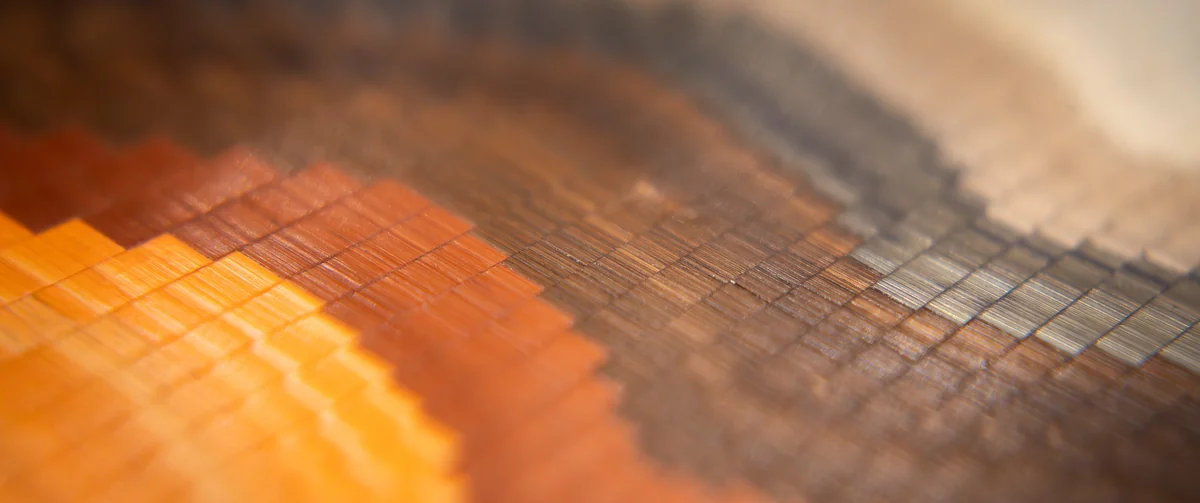
Pixel mosaic
A grid of squares laid in four directions gives four tones from one straw, enough to draw an image in pixels.
Six-point star lattice
Six-point stars of six rhombi set tip to tip, with a rhombus in every gap. A classic six-fold geometry from Islamic ornament.
Twelve-fold rosette
A twelve-point star of rhombi inside a dodecagon, ringed by twelve squares and twelve narrow triangles, on a field of rays.
Ten-fold girih rosette
A ten-point star in a decagon with a regular pentagon on every edge, in the manner of Persian girih ornament.
Lattice screen
Crossing bars on the diagonal with open diamond cells, the geometry of mashrabiya screens, with each part laid along its own axis.
Sunburst
Strips radiate from a single point. Every wedge catches the light differently, so the burst appears to turn.